

The forex (FX) market is where currencies are bought and sold. It is the largest financial market in the world: according to the Bank for International Settlements, FX trading averaged $9.6 trillion a day in April 2025, up 28% from 2022. The UK is the biggest trading centre, with about 38% of global turnover.
Most UK retail traders access forex through CFDs or spread bets, which use leverage. That makes forex trading accessible, but also very risky. Below we set out the main pros and cons of forex trading for UK traders and the brokers we would consider. If you use MetaTrader, see our guide to the best MT4 brokers in the UK.
CFDs and spread bets are complex instruments and come with a high risk of losing money rapidly due to leverage. Between 52% and 73.6% of retail investor accounts lose money when trading CFDs with the providers in this article. You should consider whether you understand how CFDs work and whether you can afford to take the high risk of losing your money.
Forex pros
Accessibility: you can open an account online and start with a small deposit. The market trades 24 hours a day, five days a week, as trading moves from Sydney and Tokyo to London and New York.
High liquidity: because of the size of the market, major currency pairs such as EUR/USD and GBP/USD can usually be traded in large amounts without moving the price much, and with tight spreads.
Low trading costs on major pairs: most brokers charge no commission on standard accounts and earn from the spread. On major pairs, spreads can be below one pip. Raw spread accounts charge a small commission instead.
Trade in both directions: with CFDs and spread bets, you can profit from a currency falling as well as rising.
Tax-free spread betting: in the UK, profits from spread betting on currencies are currently free of Capital Gains Tax and stamp duty. CFD profits are taxable. Tax treatment depends on your circumstances and can change.
Forex cons
Leverage cuts both ways: FCA rules cap leverage for retail clients at 30:1 on major currency pairs and 20:1 on other pairs. At 30:1, a £1,000 deposit controls a £30,000 position, so a 1% move against you costs £300, or 30% of your deposit.
Most retail traders lose money: the providers in this article report that between 52% and 73.6% of retail CFD accounts lose money.
Offshore brokers: many forex brokers that target UK traders aren’t authorised by the FCA and offer leverage of up to 1,000:1. If you use one, you lose access to the Financial Ombudsman Service and the Financial Services Compensation Scheme (FSCS). Always check the broker on the FCA register and the FCA warning list.
Volatility and overnight costs: prices can jump on economic data or central bank decisions, and positions held overnight pay a funding charge, which adds up over weeks and months.
How to trade forex in the UK
Choose an FCA-regulated broker, start with a demo account and decide how you want to trade: CFDs, spread bets (UK only, tax-free profits) or spot FX conversions. These are three brokers we would consider:
1. eToro

Pros:
- CopyTrader lets you copy other traders from $200
- No commission on real stocks and ETFs (other fees may apply)
- Free demo account with $100,000 in virtual funds
Cons:
- Forex only through CFDs, with no spread betting or MT4
- 0.75% fee to convert pounds to dollars
eToro was founded in 2007 and its parent company has been listed on Nasdaq since May 2025, with 4.28 million funded accounts in mid-2026. You can trade currency pairs as CFDs alongside real stocks, ETFs and crypto, and use CopyTrader to copy the trades of other users.
Forex CFDs carry no commission but have a spread, and positions held overnight pay overnight fees. UK clients can hold a GBP account with free withdrawals, and eToro has had no inactivity fee since 28 May 2026. eToro (UK) Ltd is authorised and regulated by the FCA (FRN 583263), and support is by live chat and tickets.
CFDs are complex instruments and come with a high risk of losing money rapidly due to leverage. 52% of retail investor accounts lose money when trading CFDs with this provider. You should consider whether you understand how CFDs work and whether you can afford to take the high risk of losing your money.
2. Interactive Brokers

Pros:
- Very low FX costs: 0.002% of the trade value ($2 minimum)
- Real currency conversions as well as forex CFDs
- Stocks, ETFs, options and futures in the same account, plus an ISA and SIPP
Cons:
- Complex platform for beginners
- No spread betting or MT4
Interactive Brokers (IBKR) was founded in 1978 by Thomas Peterffy and is listed on Nasdaq (ticker IBKR). It suits experienced traders who want direct access to the interbank FX market at a very low cost, alongside more than 150 other markets.
Currency conversions cost 0.002% of the trade value, with a $2 minimum, so converting £10,000 costs about $2 to $3. There are no account fees or minimum deposit. Interactive Brokers (U.K.) Limited is authorised and regulated by the FCA (FRN 208159).
CFDs are complex instruments and come with a high risk of losing money rapidly due to leverage. 58.9% of retail investor accounts lose money when trading CFDs with IBKR. You should consider whether you understand how CFDs work and whether you can afford to take the high risk of losing your money.
3. Pepperstone
Pros:
- More than 90 FX pairs
- CFDs and spread betting on MT4, MT5, cTrader and TradingView
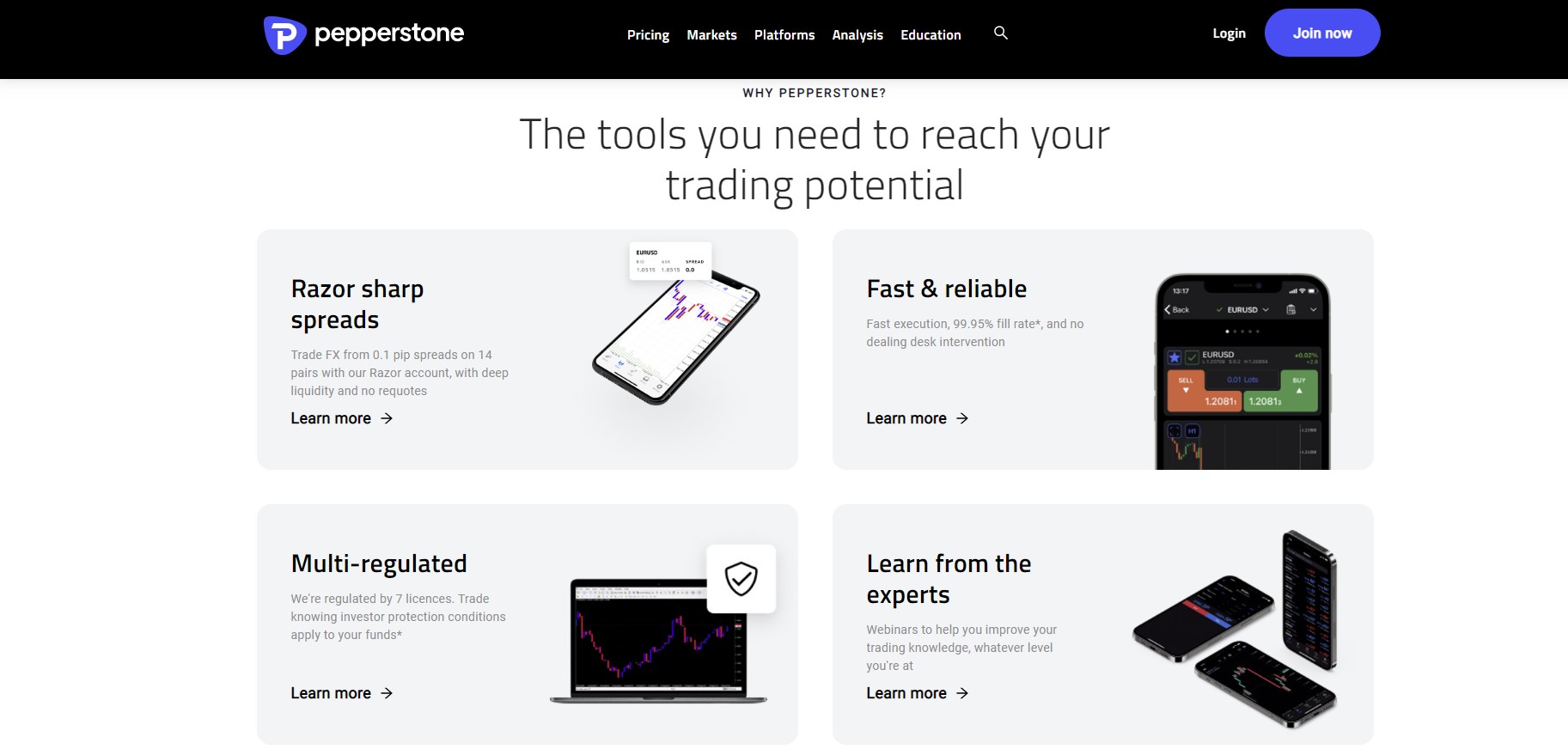
- Raw spreads from 0.0 on the Razor account
Cons:
- No real shares or ISA
- 73.6% of retail accounts lose money
Pepperstone was founded in Melbourne in 2010 and specialises in forex and CFDs. It offers more than 90 currency pairs as CFDs or spread bets. The Standard account charges no commission, with FX spreads from 0.6 points. The Razor account has raw spreads from 0.0 plus a commission from £2.25 per lot per side. Pepperstone Limited is authorised and regulated by the FCA (FRN 684312).
Spread bets and CFDs are complex instruments and come with a high risk of losing money rapidly due to leverage. 73.6% of retail investor accounts lose money when spread betting and/or trading CFDs with this provider. You should consider whether you understand how spread bets and CFDs work and whether you can afford to take the high risk of losing your money.
Final remarks
Forex is the world’s largest market, at $9.6 trillion a day, and it’s easy to start from the UK. Its main appeal is liquidity, low costs on major pairs and, with spread betting, tax-free profits. The downside is leverage: at the FCA’s 30:1 limit, a 1% move can wipe out 30% of your deposit, and most retail accounts lose money.
If you want to try it, use an FCA-regulated broker, start on a demo account and only risk money you can afford to lose.